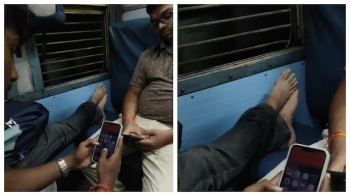
“Based on recent safety upgrades by Indian Railways, advanced Fire and Smoke Detection Systems (FSDS) in air-conditioned coaches are designed to automatically incapacitate train movement during a fire emergency to prevent the fire from spreading due to air velocity.” (nr.indianrailways.gov.in)
“When the smoke detector senses a significant amount of smoke or fire, the system interfaces with the air-brake system to automatically reduce brake pipe pressure bringing the train to a halt.”
The system automatically resets after troubleshooting, allowing the train to resume movement after the hazard is cleared.
The ‘Coimbatore Hisar AC Superfast Express’ is fully air-conditioned and the loco-pilots had to check each and every one of the 20 bogies of the train before the source of smoke was removed.
An inconsiderate passenger’s thoughtless act had brought about such a disruption!
For that matter, it is observed that train travel often brings out toxic behaviour in passengers.
The exhibition of unpleasant mannerisms which significantly amplify within the bogies during long-distance travels speaks for that mindset popularly referred to as a ‘tragedy of commons’, where public places are treated with less care than private property.
I have travelled in trains boarding both from the starting as well as intermediate stations along many routes in the complex maze that makes up the railways in the country.
The ‘cascade of littering’ is a persistent and complex issue facing Indian Railways. This phenomenon, which turns railway tracks into ‘hidden junkyards’, often sees trains starting in a clean condition, only to become covered in waste within a few hours.
It is however surprising to note that air-conditioned compartments in Indian Railways often struggle with issues similar to non-AC coaches negating the expected comfort despite higher fares.
Accustomed to travelling in top-tier accommodation or AC 2-Tier in Indian Railways, I am no stranger to the disgusting ways of some travelers which not only creates an unpleasant environment around, but also merits a special mention here.
AC coaches in Indian trains, while offering a more comfortable, closed-door environment than sleeper-class, are not immune to frustrating and sometimes bizarre passenger behaviour.
Due to a perceived ‘entitlement’ culture and a lack of civic sense, co-passengers often experience high levels of inconvenience, despite paying for premium comfort.
Even otherwise, quirky, inconsiderate, and frequently frustrating passenger behaviours in AC-coaches on Indian Railways have become a notable, albeit chaotic, part of the travel experience, often blurring lines between premium, comfortable travel and general class conditions.
Although these issues have prompted widespread debate about civic responsibility and the need for stricter enforcement on trains, the oblivious behaviour of some passengers continues to undermine these efforts. The railway authorities too have turned a blind eye to these incidents.
Various modes of travel too have evolved over the years to narrate their own tales of woes regarding the behaviour, expectations, and types of travellers availing them. It is observed that modern transportation, while faster and more accessible, now deals with passenger-driven issues.
But then again, it is not the mode of travel as much as the people utilizing the services who have invited scrutiny for their inexplicable and obnoxious habits which turn shared journeys into stressful experiences.
As a person who travels extensively, I have often seen exhibitions of ‘uncouth’ and ‘uncivilized’ mannerisms by co-travelers.
Call it the ‘Hoi Polloi’ syndrome if you must, but it is the lack of public etiquette and basic manners, often characterized by inconsiderate behaviour, such as ignoring queues, loud phone conversations in quiet areas, and disregarding personal space which makes travelling with such people an agonizing experience.
While the sophistication of new railway stations and the curated glamour of travelling by ‘Vande Bharat’ and such other premier trains do serve to elicit an appropriate response from travellers, some of them are not averse to carrying their inconsiderate habits into the compartments.
It is argued that Indian Railways is a lifeline for the common man and not a premium service like the airlines. People travel by train out of need and not by choice.
Yet, when one considers the manner in which the Railways has transformed into a premium travel experience for Indians by upgrading to high-speed, amenity-rich, and themed trains, offering a blend of modern comfort and luxury; expectations from people availing these services would naturally border on something akin to respect for the facilities provided.
These improvements cater to the evolving needs of modern travellers seeking comfort, speed, and unique, experiential journeys across India.
However, Vande Bharat Express trains, India’s premium, high-speed service, have frequently faced issues with seats being torn, stained, and soiled by passengers, with reports of damage to armrests, broken snack trays, and heavy littering appearing within months of service.
This nevertheless highlights the tension between providing modern rail travel and coping with passengers who lack civic sense and fail to respect public property.
While passengers play an active role in their own travel experience, it is equally essential that they take proprietorship of their own behavioural responsibilities. Respect for fellow passengers is of essence whenever travelling.
Maintaining decorum in public transport is essential because it is a shared space where one person’s carelessness becomes everyone’s annoyance. Proper passenger etiquette ensures a pleasant experience, safety, and efficiency for everyone.