Vision of 'Green
Innovation Economy'
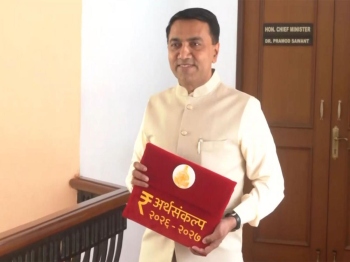
A central theme of this budget is the concept of a “Green Innovation Economy,” which blends environmental sustainability with economic self-reliance. For a state historically anchored by tourism and mining, the shift marks a notable transformation in development strategy.
Innovation, sustainability and inclusion were recurring motifs in the budget speech, underscoring the government’s intention to move beyond post-pandemic recovery measures toward long-term structural change. Initiatives include solar-power subsidies for fishing communities, grants for women-led eco-handicraft cooperatives, and state-funded hackathons aimed at fostering youth innovation.
Entrepreneurship and green infrastructure together account for nearly 15 per cent of the proposed expenditure of about Rs 3,375 crore, double the allocation of the previous fiscal year. Mining, once the backbone of Goa’s economy, is being repositioned through initiatives such as bio-mining and blue-economy projects aligned with environmentally responsible development.
Strong fiscal
indicators
Goa’s fiscal health remains relatively robust compared with many Indian states. The budget projects economic growth of around 12 per cent, higher than the national growth estimates of roughly 10“11%. The state anticipates a revenue surplus of about Rs 2,882 crore, equivalent to roughly 2.2% of GSDP, improving on last year’s 1.7%. This surplus is expected to be supported by higher tax revenues, including a projected Rs 4,800 crore in State GST collections.
Development expenditure forms the core of the budget, accounting for about 65% of total spending. Capital outlay has been increased by 20% to Rs 4,500 crore, aimed at strengthening infrastructure and public services. The fiscal deficit is projected at 1.9% of GSDP, comfortably within limits set under the Fiscal Responsibility and Budget Management (FRBM) framework.
Central government transfers are expected to constitute around Rs7,200 crore, roughly 32% of the budget, slightly lower than the previous year’s share. Meanwhile, Goa’s debt-to-GSDP ratio is projected at about 29.5%, lower than the national average for states.
Human capital
and employment
The government has placed strong emphasis on workforce development to support emerging sectors such as information technology, green engineering and advanced manufacturing.
Unemployment in Goa has declined to roughly 4“5%, though youth unemployment remains higher. The budget allocates Rs1,200 crore, an increase of about 15%, for skill development programmes expected to train nearly 50,000 young people in fields including artificial intelligence, renewable energy and tourism management.
Infrastructure development continues to be a key priority. A major allocation of Rs 2,000 crore has been proposed for the “Goa Connect” highway project linking the new international airport at Mopa with the commercial hub of Margao. The corridor is expected to improve logistics efficiency and support tourism and trade.
To attract high-technology manufacturing, the state government has also announced incentives for semiconductor and electronics industries. Policy measures include tax incentives for hybrid and electric vehicles and rebates on aviation fuel to encourage greater air connectivity.
Sector-wise
investments
The budget earmarks Rs1,800 crore for education, including the creation of 10 vocational training hubs designed to integrate traditional Goan cultural knowledge with modern digital skills. Tourism, which contributes a significant share of Goa’s economy, will receive Rs 900 crore for eco-tourism infrastructure, digital tourism platforms and sustainable resort development.
About Rs 600 crore has been set aside to boost aquaculture productivity and climate-resilient farming, sectors that support a substantial portion of rural households. A Rs1,000-crore green transition fund will support solar micro-grids, mangrove conservation and climate-resilient infrastructure. In addition, a Rs 400-crore startup seed fund aims to support up to 5,000 emerging enterprises, with a special focus on women-led businesses.
Balancing growth
with challenges
Despite the optimistic outlook, some concerns remain. Industry groups have expressed apprehension over proposed increases in certain property and house taxes, warning that higher compliance costs could strain small and medium enterprises. Business associations have suggested capping the levy to ensure continued access to credit for MSMEs.
Goa’s heavy dependence on tourism exposes it to global economic fluctuations and climate risks. Diversifying into technology, manufacturing and green industries will therefore be crucial for long-term resilience.
Blueprint for
sustainable prosperity
Overall, the 2026“27 budget outlines a clear strategy: leverage Goa’s fiscal strength to build a diversified, environmentally responsible economy. By combining infrastructure development, green investments and human capital initiatives, the government hopes to position Goa as a model for sustainable growth among Indian states.
If effectively implemented, the budget could mark a decisive step toward balancing economic ambition with ecological stewardship, ensuring that Goa’s prosperity endures well beyond its traditional pillars of tourism and mining.