Disappearing
ecological infra
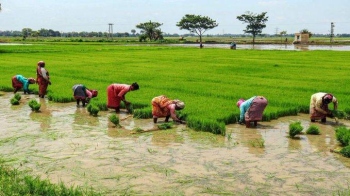
Goa’s paddy cultivation has been in structural decline for two decades. Data from the state’s Department of Agriculture shows cultivated area under paddy shrinking from over 50,000 hectares in the 1980s to well under half that figure today. The forces driving this decline are familiar: urbanisation, the lure of land monetisation, an ageing farming population, and a severe shortage of agricultural labour as younger Goans move into the service economy. Paddy farming is physically demanding, seasonally intense, and economically marginal when measured purely against market prices for rice. By conventional accounting, it barely competes.
But conventional accounting is precisely the problem. It prices the rice and ignores everything else.
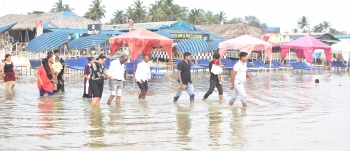
Paddy fields in Goa, particularly the khazan lands of the coastal lowlands and the terraced fields of the interior, are not simply platforms for growing grain. They are working ecological systems. During the monsoon, they absorb and slow the movement of enormous quantities of rainfall, functioning as distributed flood buffers across the landscape. When those fields are abandoned or converted, that buffering capacity disappears. Rainwater that once spread across a flooded field and percolated gently into the soil now rushes into storm drains and streams, amplifying peak flows downstream. The flooding that has increasingly disrupted Panaji, Margao, and dozens of smaller settlements in recent years is not solely a drainage infrastructure problem. It is, in part, a paddy field problem.
Groundwater tells a similar story. Much of Goa’s rural drinking water depends on shallow aquifers recharged by slow percolation through agricultural land. Remove the paddy fields, pave the surface, and you interrupt the recharge cycle. The borewell that serves a village today may not serve it reliably in twenty years.
Cultural and
economic dimension
The loss is not only hydrological. Goa’s paddy cultivation is embedded in a web of cultural practice ” the festival calendars, the community labour arrangements, the architecture of rural homesteads designed around the cycle of planting and harvest.
Local food security matters in ways that go beyond sentiment. Goa currently imports a significant share of its rice consumption. This dependency is invisible when supply chains function smoothly, but it becomes visible quickly during disruption ” whether that disruption comes from a prolonged monsoon failure in producing states, a logistics breakdown, or the kind of supply shock that the pandemic briefly demonstrated was always possible. A state that grows some portion of its own staple is less exposed than one that grows none.
What Goa’s
future requires
A number of initiatives within the Mission LiFE framework ” the Government of India’s programme for Lifestyle for Environment ” are actively promoting the idea that sustainable land use requires citizens, communities, institutions, and governments to act in concert. In Goa’s context, this means recognising paddy fields not as underperforming assets waiting to be unlocked, but as ecological infrastructure that delivers services the market does not price but society cannot afford to lose.
IIT Goa has been working with local communities and panchayats and has plans to document these ecosystem services and to develop frameworks that could eventually support payment mechanisms for farmers who maintain paddy cultivation. The logic is straightforward: if a farmer’s field is buffering floods that would otherwise damage downstream property, the farmer is providing a service.
Several practical pathways exist. Land use regulations that distinguish between genuinely vacant land and ecologically active fallow paddy fields would be a start. Agri-tourism models that connect Goa’s substantial visitor economy with authentic agricultural experience have been piloted successfully in parts of Kerala and Uttarakhand and deserve serious trial here. Youth-oriented programmes that combine agricultural skill-building with environmental education, framed not as a retreat to the past but as a forward-looking engagement with food systems, climate adaptation, and rural enterprise, could begin to shift the perception that farming is something Goans have grown out of.
Collective farming arrangements, supported by panchayats and agricultural cooperatives, can address the labour constraint that defeats individual smallholders.
An invitation,
not a lament
The egret in the flooded field is not a postcard image. It is an indicator species ” a sign that the system is still functioning. When the fields go, the egret goes. So does the flood buffer, the groundwater recharge, the food security margin, and something harder to name but easy to feel when it is missing: the particular quality of a landscape that has been tended, for centuries, by people who understood it.
Goa is not obligated to choose between development and its paddy fields. That is a false choice, and accepting it uncritically is itself a policy decision with consequences. The more honest question is whether the institutions, communities, and citizens of Goa are willing to ask what these landscapes are actually worth ” and to act on the answer before the fields, and the choice, are gone.