The mining sector in Goa has increasingly come under public scrutiny. Iron ore mining activity was halted in the year 2012 on account of large-scale illegalities and environmental concerns. It is interesting to note that although iron ore mining per se is a polluting activity, most people are in favour of regulating this sector rather than completely banning it. That is why the Government has been able to auction the iron ore mineral blocks as per the Mineral Auction Rules 2015 and resume mining. The story of sand mining is also no different. While the State is suffering from non-availability of sand due to the stoppage of legal sand mining for many years, the Government is entangled in a legal battle at NGT Pune regarding the sustainability and procedural aspects of sand mining in Goan rivers.
Land is a scarce resource. People are highly possessive and reluctant to part with their land. The State’s inability to acquire land even for a project like IIT itself is a testimony. The challenges include conversion of ecologically sensitive lands like private forests, orchards etc. to settlement zones, particularly under the disputed Section 17(2) and 39(A) of the TCP Act, illegalities in Comunidade land, hill cutting, felling of trees etc. The recent civil society movement Enough is Enough, led by Ferdino Inacio Rebello, former Chief Justice of Allahabad High Court, has put pressure on the Government seeking amendments to the TCP Act. Another chronic issue is the award of land acquisition compensation in the name of occupants reflected in outdated land records, who are non-existent and mostly dead. Thus, the authorities have been finding it difficult to identify the rightful owners for the payment of disbursement in the absence of legally binding land ownership succession documents. For example, in the Mopa Airport project, which is the largest land acquisition the State of Goa has ever done, only about 35% to 40% compensation has been disbursed and the balance is deposited with the District Court/Fast Track Court to decide on the rightful owners for the disbursement of compensation. The Government is also experiencing difficulty in land acquisition due to procedural complexity under the Right to Fair Compensation and Transparency in Land Acquisition, Rehabilitation and Resettlement Act, 2013.
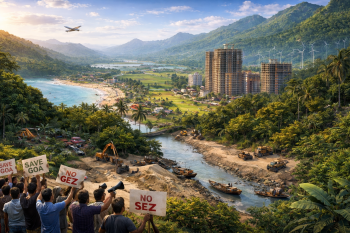
However, while on the one hand the vigilant civil society is advocating balanced development, the paradox is that there are cases where Goan people are selling their lands for financial gains, mostly purchased by people from other States for tourism-related projects, real estate projects etc. Projects face opposition due to perceived environmental impact, fear of population influx leading to possible demographic changes, and pressure on basic amenities etc. Recent examples include the cancellation of the Unity Mall and Prashasan Stambh projects, and keeping in abeyance certain approvals granted under Section 39(A).
The irony is that while the State has been acquiring land and allowing tree cutting, it does not have enough land for afforestation. As per a reply given to starred Question No. 202 dated 18-12-2025 in the Rajya Sabha, so far an amount of Rs.518.85 crore has been released to the State of Goa for utilisation of CAMPA funds under the National Green Mission. A substantial amount has remained unutilised, as evident from a June 2025 report that the State has around Rs.406 crore in its CAMPA kitty (The Goan, 25th June 2025).
Another major issue faced in the State is the NIMBY (Not in my backyard) syndrome. While Goa is considered one of the most progressive States, sewerage network coverage in Goa is relatively low. Only about 16% of the State’s population is connected to the underground sewer network. While the majority of the State relies on septic tanks and soak pits, only Panaji, part of Margao and Vasco have a functional underground sewer network. A similar situation exists with Solid Waste Management. While people want solid waste and sewage to be handled scientifically, they do not want a solid waste management plant or sewage treatment plant in their area. Therefore, such projects face inordinate delays in implementation.
Unlike districts in other States, which are primarily governed by a District Collector, Goa’s governance is controlled by the State Government, headed by the CM and 11 Cabinet Ministers, supported by multiple departments, public sector undertakings, and other government bodies. District Collectors have a limited role, mainly handling revenue matters. Although Zilla Panchayats exist as per the Constitutional mandate, they remain largely ornamental with minimal powers. Village panchayats too have yet to receive all functions envisaged under the 74th Constitutional Amendment. Goa has a large bureaucracy of over 60,000 employees; excluding those under 18 and over 60, roughly one in 15 residents is a government worker. In a bid to improve administrative efficiency, the Government officially notified a third district on 31 December 2025 for hinterland taluks. However, structural changes alone are unlikely to resolve governance challenges.
Development in Goa faces natural constraints, including extensive forest cover, reserve forests, national parks, biodiversity-rich Western Ghats, environmentally sensitive zones identified in the Kasturirangan report, potential Tiger Reserve Corridors, coastal restrictions, wetlands, and undulating, hilly terrain. These ecological and topographical factors make navigating the State’s development agenda particularly complex and challenging for the Government.
(The author is a retired senior bureaucrat)