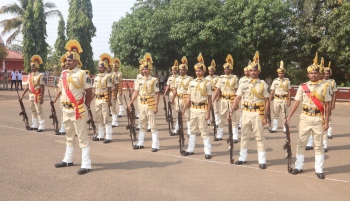
Even more perplexing is that five of the newly promoted officers continue to hold the same posts of deputy superintendent of police (DySP) that they were occupying prior to their promotion. This is, quite frankly, an affront to the rank they now wear on their shoulders. Nothing illustrates the absurdity better than the case of a 1991 batch officer who continues to serve as DySP (Coastal) even after his promotion to SP. He now reports to an officer from the same promotion list, a 1997 batch officer who is five years his junior, posted as SP Coastal.
Such arrangements demonstrate that the promotions and postings were made without due application of mind and in a manner that appears injudicious, raising uncomfortable questions about the considerations that guided these decisions.
The situation is no less puzzling when one examines the postings of officers from the IPS cadre. Young and capable IPS officers who have recently joined the Goa police are left demoralised, while experienced officers inducted into the cadre from Goa remain in a state of uncertainty.
The district posts of North Goa, South Goa, and the newly created Kushawati district are designated cadre posts. Yet these have been allotted to non-cadre officers. To add insult to injury, the new district has been given as an additional charge to a non-cadre IPS officer, while IPS officers themselves have been relegated to largely non-executive postings. Ultimately, the loss is not merely institutional. It is borne by the citizens of Goa.
For a police officer, dignity and reputation are inseparable from rank and uniform. Once that dignity is undermined, restoring authority becomes difficult. The erosion of authority inevitably leads to a trust deficit not only among citizens but also across institutions such as the courts. This demoralisation can weaken the force and make it vulnerable in moments of crisis.
It must be remembered that the police are the face of the state, functioning 24 hours a day, unlike most other government departments whose responsibilities operate within limited hours. If the police system falters, the consequences are grave, for the collapse of law enforcement can invite constitutional breakdowns and extraordinary interventions.
One such questionable precedent is the practice of officers wearing their new rank immediately upon promotion, even before assuming the corresponding post. In principle, an officer is promoted against a vacant position and is entitled to the rank and salary only after relinquishing the old post and joining the new one. Until then, the officer continues in the earlier rank and draws the corresponding salary.
This rule is strictly followed in neighbouring Maharashtra. I recall that a batchmate of mine, promoted to SP, could not be relieved from his position as SDPO for several months due to administrative exigencies. During that period, he continued to function and wear the rank of DySP until he formally joined his promoted post.
When systems become compromised, professionalism inevitably suffers. Goa Police risks sliding into such a decline, which would undermine its proud motto: Shanti, Seva, Nyaya... peace, service and justice.
Former DGP B. S. Bassi was so impressed by this motto that after assuming charge as commissioner of police in Delhi, he adopted the same for the Delhi Police. The motto itself was conceived by a Goa Police Service officer who was SP (Headquarters) at the time. It is a simple and community friendly expression that provides direction and purpose to the force.
In the current round of postings and transfers, one wonders whether the views of the director general of police were sought. If they were sought and ignored, it raises one set of concerns. If they were not sought at all, it raises another. And if the chief has acquiesced to these arrangements, it would be a grave disappointment for the force.
I am reminded of the distinguished civil servant R. C. V. P. Noronha, former chief secretary of Madhya Pradesh, a man of Goan origin who twice held that office. In his memoir A Tale Told by an Idiot, he recounts an incident during a meeting of collectors. A minister reportedly shouted, “You are all our naukars.” Noronha promptly responded, “Hum janata ke sevak zaroor hain, lekin kisi ke baap ke naukar nahin.” Imagine the confidence that such leadership instils in young officers.
Sadly, in recent times we often see senior officials acting more like cheerleaders for political bosses. The temptation of desirable postings has eroded the moral fibre of the services, the very “steel frame” of governance envisioned by Sardar Vallabhbhai Patel.
It gives me no pleasure to write what may sound like an obituary for the leadership of a service I once belonged to with pride. Goa Police was once guided by distinguished officers whose legacy deserves preservation, both for our predecessors who built it and for the successors who must carry it forward.
I conclude with the words of a Quaker missionary: “I shall pass this way but once. Any good that I can do, or any kindness I can show to any human being, let me do it now. Let me not defer nor neglect it, for I shall not pass this way again.”