There is also a need to define the concept of development. The conflict is visible in repeated displays of public discomfort regarding real estate projects, land acquisition for large-scale infrastructure projects and the construction of high-rise buildings, etc. The immediate post-liberation period witnessed large-scale in-migration of people from other states to fill the vacuum caused by the non-availability of both skilled and unskilled local workforce, including in government jobs. While the earlier influx of people was for jobs, the trend of late is the influx of elites from other states eyeing the economic resources of the state in terms of buying land, villas, apartments, real estate projects and tourism-oriented projects, etc. This has led to faster urbanisation of the state. As per the 2011 Census, 62.17% of the population resides in urban areas, which may have reached 75% now (guesstimate), and the actual figure may be known only after the results of the Population Census 2027 are released by the Registrar General of India. The outcome of so-called development is urbanisation. The majority of areas in Goa, though under the jurisdiction of village panchayats, have lost their village outlook. The much-touted hinterland tourism needs to be regulated so that it does not lead to the urbanisation of pristine hinterlands.
The irony is that though the state is highly urbanised, the Urban Local Bodies in Goa cover only around 22% of the population, mainly because the areas defined as urban under the Census definition are still under the jurisdiction of village panchayats. The most interesting fact is that both the Vidhan Sabha and Secretariat (literally the government) are functioning from an area that is officially under Village Panchayat Penha de Franca of Bardez taluka, while Panaji (Tiswadi taluka) continues as the capital of Goa for all official purposes. While Goa has recently amended its administrative structure by creating a third district (Kushavati), it may be appropriate for Goa to redefine its urban area boundaries, aligning them with the population census, and also bring the seat of governance, both the Vidhan Sabha and Secretariat, under the limits of the City Corporation of Panaji in Tiswadi taluka.
The changing demographic character of Goa is also to be kept in mind. At the time of liberation, the population of Goa (1960) comprised 59.92% Hindus, 38.07% Christians, 1.95% Muslims and 0.06% other religions. As per the 2011 population census, while the percentage of Hindus and Muslims has increased to 66.08% and 8.33% respectively, the proportion of the Christian population has decreased significantly to 25.10%. While in terms of absolute numbers, the population of Hindus and Muslims has increased significantly, the population of Christians has nearly stagnated (3,59,568 in 2001 and 3,66,130 in 2011). There are reports that 25,939 people have surrendered their Indian passports in Goa between January 2014 and March 2024 to acquire foreign citizenship, mainly Portuguese. As per recent reports, over 8,400 Goans surrendered their passports between 2021 and 2025, of which 8,370 acquired Portuguese citizenship. Therefore, if the trend continues, it may not be surprising if the headcount of Muslims outnumbers Christians in Goa in the long run.
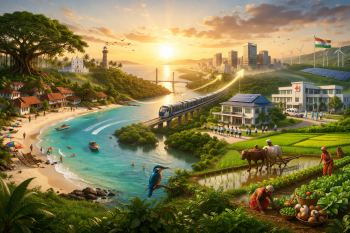
Therefore, the challenge is to articulate the concept of Viksit Goa 2037. The best example is the UN-adopted blueprint for Sustainable Development Goals (SDGs) to achieve a better, more sustainable future by 2030. The SDG blueprint has 17 SDGs and 169 sub-goals (specific measurable targets) across social, economic and environmental areas. Therefore, the immediate priority for the Goa Government will be to evolve a blueprint for Viksit Goa 2037 comprising strong and trustworthy pillars with specific measurable goals and sub-goals. There has to be a sectoral gap analysis and SWOT analysis, with sustainability and Public Trust being the ‘Mool Mantra’. The outcomes are to be measured annually with year-wise targets across sectors. The proposed Goa Happiness Index announced in the Budget is also to be integrated with the Viksit Goa 2037 blueprint.
(The author is a senior retired bureaucrat)