MAPUSA
Across Goa, the anxiety over land conversion and mega projects is no longer confined to drawing rooms or social media posts.
It has spilled onto the streets ” and increasingly into courtrooms.
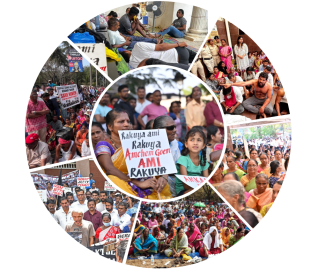
In Bardez, much like in other parts of the State, villagers are rising in protest, signalling a deepening distrust of how land-use decisions are being made.
What began in villages such as Siridao, over approvals granted under Section 39A of the TCP Act, has now found echoes in Bardez. Sporadic protests against large-scale developments, hill cutting and the filling of agricultural land have steadily grown into a broader assertion: that land in Goa cannot be treated as a commodity without consequence.
Reis Magos has emerged as a flashpoint. Residents there have strongly opposed large construction projects, particularly villa developments on the Verem-Reis Magos hill stretch. Locals argue that forests are being razed and hills carved out to make way for luxury structures aimed at investors from outside the State.
“These are not small houses for local families. Entire hillsides are being flattened for massive constructions. If we keep quiet now, we will lose the last of our green cover,” said one resident.
Fear of irreversible damage
The fear is not merely aesthetic. Villagers point to the loose laterite soil and warn of landslides, depletion of wells and irreversible damage to biodiversity, including cashew groves and wild trees that have defined the landscape for decades.
Though developers maintain that all statutory approvals ” including Environmental Impact Assessments ” have been obtained, residents insist the projects encroach upon No Development Zones and biodiversity-sensitive areas along the Mandovi.
The battle has moved to the judiciary, with petitions being heard by the Bombay High Court. While the State has previously maintained that no illegal hill-cutting was detected, villagers have sought judicial scrutiny, reflecting a growing trend of communities turning to courts when administrative remedies fail.
'Mega intrusion'
Adding to the growing unease over large-scale projects, residents of the Verem-Reis Magos belt are now confronting what they describe as yet another “mega” intrusion ” a proposed five-storey offshore casino to be stationed along the Verem side of the Mandovi River. The plan has triggered fresh anxiety in a village already grappling with concerns over intensive development. Villagers have voiced strong opposition to the proposed casino, arguing that it would alter the character of the area and add further strain on the fragile riverfront ecosystem.
Further north in Tivim, a similar resistance has taken shape over the allotment of vast tracts of land for a private university project. Even after a Public Interest Litigation was dismissed, protests have continued. Residents allege large-scale hill-cutting and tree felling at the site and have announced plans to approach the Supreme Court.
“If we don’t protest, we will soon become outsiders in our own land. This is not development for the people of Goa. It feels like decisions are being taken behind our backs,” said Godfrey D’Lima, a local and member of the comunidade.
From Reis Magos to Tivim, the message is becoming sharper.
Bardez is not witnessing isolated objections but part of a larger, State-wide movement ” one that questions not just individual projects, but the model of development itself.