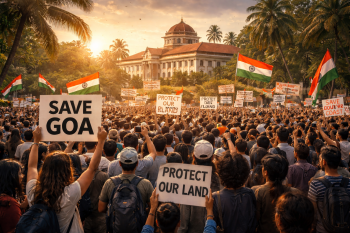
Something has to give way. The antagonists have taken their stands and shown their intent. There are so many conflicting interests -- and perspectives -- involved that one can’t imagine how things could possibly end up. Unless this becomes another of those Goan farces, where there’s a lot of grandstanding but it ends up in little or nothing. Public protests over the interpretation or application of Article 39(A) in Goa could lead to one of several possible outcomes. Firstly, the government may offer the olive branch, as Chief Minister Pramod Sawant seemed to be willing to do at some stage of the dramatic standoff (before quickly opting for tough talk).
Officialdom and our political class may offer formal statements or amendments to rules. They could appoint a committee or expert panel to review concerns voiced by citizens and campaigners. Or they may seek judicial interpretation if the issue raises constitutional questions. A sustained mobilisation could also influence legislative debate or electoral politics. This could be true if Opposition parties seriously and persistently adopt the issue. But this seems like expecting too much, given the way a fractured Opposition works in Goa.
Alternatively, if negotiations stall, the matter may move to the courts, where a High Court or the Supreme Court could settle questions of scope and implementation. Much will depend on the level of public support, the clarity of the protesters’ demands, and the State’s willingness to engage in dialogue rather than treat the agitation purely as a law-and-order issue.
Architect and urban planner (with an activist flavour) Tahir Noronha has made an appeal to citizens on the eve of the Goa Assembly session. He suggested that as legislators gather for their 15-day session, citizens need to remind their representatives to “speak about issues that concern us: over-construction; water shortages; conversion of fields, hills and forests; and the breakdown of planning.”
Tahir went on to argue that Section 39A has reshaped Goa with minimum public consent. He urged citizens to ask their MLAs whether they (the MLAs) would demand the repeal of 39A with retrospective effect. If not that, at least discuss it in the upcoming budget session. Or at least allow their voters to come and witness the discussion.
Before we get lost behind clichés, let’s remind ourselves of what this means: Section 39A of the Goa Town and Country Planning (TCP) Act, 1974 is the newly inserted provision (brought in by the 2024 amendment) that empowers the Chief Town Planner (Planning) ” on government direction or on receipt of an application and with the approval of the TCP Board ” to alter or modify the land-use zoning in the Regional Plan or the Outline Development Plan to effect a change of zone of parcels of land.
This is subject to prescribed procedures, including a 30-day public notice and invitation for suggestions. It excludes eco-sensitive lands. Essentially, it creates a statutory route for case-by-case alterations to the approved planning maps that was previously possible only in more limited circumstances.
Justice Ferdino Rebello (Retd) deserves credit for putting this pending issue on the agenda once again. It affects all those who care for the Goa of tomorrow, and also everyone in a hurry to make a fast buck from land speculation.
On the other hand, the authorities suggest that protests and changes sought should be undertaken through proper channels. News reports said the Chief Minister had made the point that while people have the right to protest, they should maintain decorum. Taking the law into their own hands was not correct, he contended. Further, he urged protesters and MLAs “not to hold protests at ministers’ residences due to personal privacy”. He went on to maintain that the 39A case was “ongoing in court” and that “discussion can be held there”. Furthermore, he said no permission had been taken for the protests which made headlines last week, nor had any route been decided for them.
Yet there can be other points of view on this. A democracy does not treat protest as a favour to be “permitted” at convenience, but rather as a constitutional right that may be reasonably regulated, not pre-emptively curtailed.
Maintaining peace and public order is essential. Yet invoking “decorum” or pending litigation as grounds to discourage demonstrations could mean narrowing the very space through which citizens express dissent. Court proceedings and street protests serve different functions. The former adjudicates legality. On the other hand, the latter signals public sentiment and democratic accountability. It is understandable, for administrative reasons, that prior permission may be necessary or that routes should be fixed. Yet such requirements should facilitate, and not frustrate, lawful assembly.
If people feel unheard, especially on contentious matters like Section 39A, then surely protest becomes a form of participatory politics. Not lawlessness. The State’s role is to ensure safety and dialogue, not to imply that dissent near centres of power is inherently improper.
In his interesting and well-documented analysis (written in Gerard’s Gazeette on substack.com; see [https://gerardsgazette.substack.com/p/the-highs-the-lows-and-the-lies-they](https://gerardsgazette.substack.com/p/the-highs-the-lows-and-the-lies-they)), the journalist Gerard DeSouza writes: “For one, there is no right or wrong way to protest. Protests are meant to disrupt and often turn violent. By contrast, the gatherings held both at Azad Maidan and at Dona Paula were the very definition of peaceful. No one was hurt, no property was damaged, no roads were blocked (except by the police), and inconvenience to the public was minimal!” The true test will be how conflicting visions between those in power and the common citizen are sorted out. History will tell us how it played out; but this time, nobody will be able to say, “The citizen didn’t stand up.”