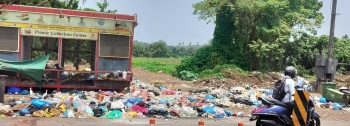
While the Mapusa Municipal Council (MMC) has over the years introduced a series of measures to curb indiscriminate garbage disposal, the persistence of black spots across the town and its outskirts suggests that the problem is far from under control. The incident has triggered a wider debate on whether the administration’s focus should shift from punitive action against individual offenders to addressing deeper structural deficiencies in waste management.
CIVIC STEPS YET TO DELIVER RESULTS
The civic body has outsourced door-to-door garbage collection, imposed fines on violators, deployed workers to clear garbage black spots daily and established facilities for the collection of dry waste. Yet, open dumping remains rampant in several parts of the town.
Residents of Guasavaddo, where the controversy originated, alleged that garbage from some households has not been collected for the past several days. They claim irregular collection by outsourced workers often leaves residents with little option but to store waste indefinitely or dispose of it elsewhere.
Among the areas repeatedly affected by open dumping are Guasavaddo, Camarcazana, Acoi, Karaswada, Khorlim, the old Asilo hospital vicinity, the Mapusa Urban Bank area, the main market, Morod, Canca bypass etc.
Municipal workers clear these sites almost every day, but fresh heaps reappear within hours, highlighting the limitations of the current strategy.
PANCHAYAT FACTOR
The problem extends beyond municipal limits. Several panchayats surrounding Mapusa lack adequate infrastructure for wet waste collection and processing. Most have only Material Recovery Facility (MRF) sheds meant for dry waste segregation, while facilities for handling organic waste remain either inadequate or non-existent.
As a result, garbage generated in neighbouring villages frequently finds its way into Mapusa. Roadsides, vacant plots, bypass stretches and city-entry points have increasingly become dumping grounds for waste brought from adjoining areas.
Local residents argue that unless neighbouring panchayats develop effective systems for managing both wet and dry waste, Mapusa alone cannot solve the problem.
CALLS FOR A NEW APPROACH
The municipality has also set up two modern facilities under a Corporate Social Responsibility (CSR) initiative for accepting dry waste.
However, officials acknowledge that many residents continue to discard recyclable materials such as cardboard, glass bottles and packaging waste at unauthorised locations.
Former Mapusa Chairperson Sandip Falari said the recent tragedy should serve as a wake-up call for authorities.
“No one supports open dumping of garbage. But the larger question is whether the system itself is functioning effectively. We are not only voters but also consumers as we pay garbage tax. So MMC is service provider,” Falari said.
The unfortunate incident with the student has exposed the complexities surrounding waste management in one of State’s busiest urban centres.
Increasingly, residents and civic observers believe the answer lies not merely in fines and enforcement but in a coordinated regional waste-management strategy, stronger collection systems, decentralised processing facilities and greater public participation.
For the Mapusa Municipal Council, the challenge now is not just to remove garbage from the streets, but to think beyond conventional solutions and address the root causes that continue to fuel the waste menace.