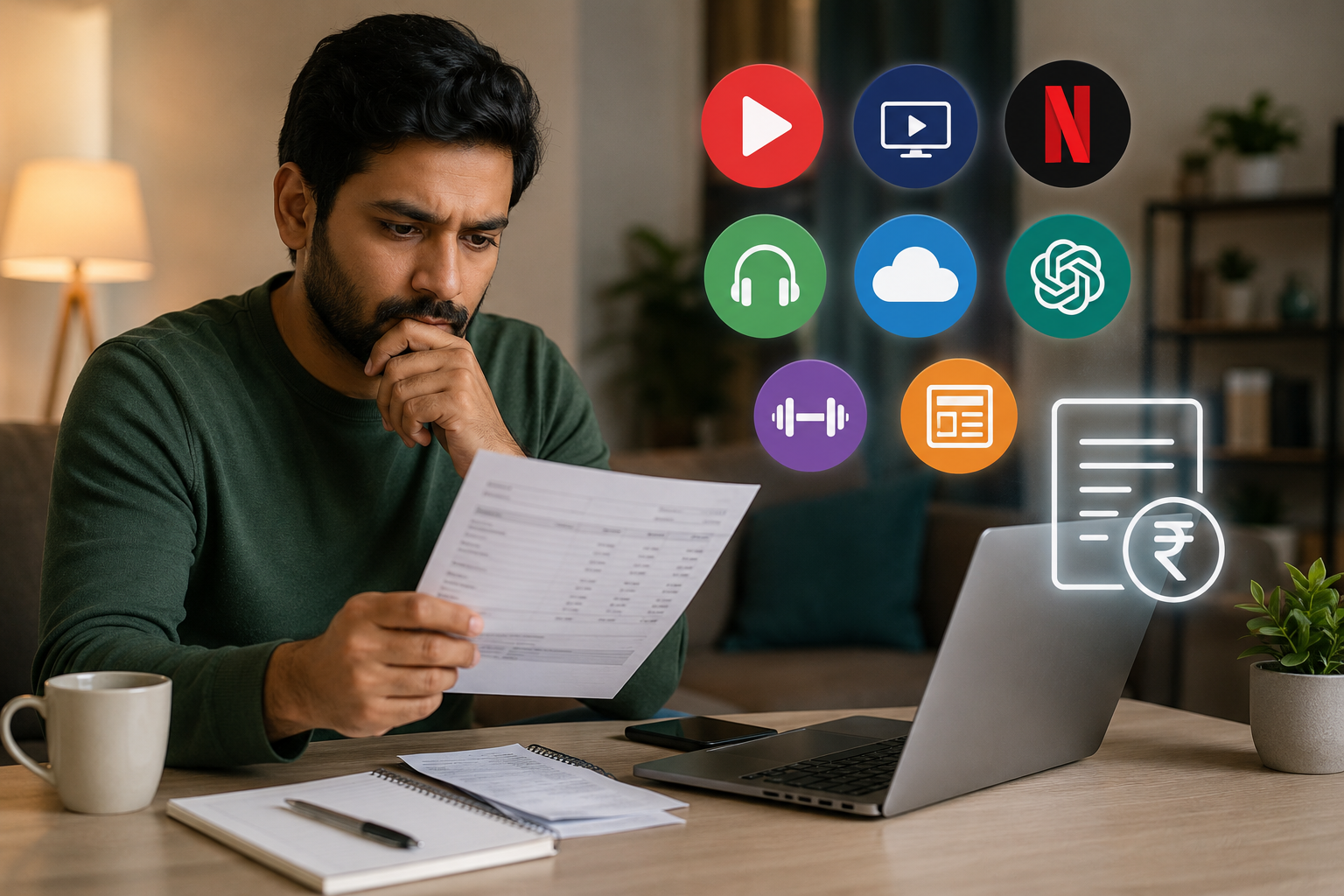
Rohit, a 32-year-old marketing professional, was reviewing his credit card statement when he noticed a charge he did not recognise. It turned out to be a streaming service he had signed up for nearly a year earlier to watch a single series. Curious, he began checking other recurring payments. By the end of the exercise, he discovered he was paying for three streaming platforms, a music service, cloud storage, an AI tool and a fitness app.
The total came to more than Rs 3,000 a month.
Like many consumers, Rohit had not consciously decided to spend that amount every month. Instead, the subscriptions had accumulated gradually, one small payment at a time.
Rise of subscription creep
A decade ago, most households had only a handful of recurring payments. There was the electricity bill, mobile phone recharge, internet connection and perhaps a cable television subscription.
Today, many people pay monthly or annual fees for streaming platforms, music services, cloud storage, fitness apps, digital newspapers, antivirus software and artificial intelligence tools. Individually, these subscriptions often appear affordable. A charge of Rs 149, Rs 199 or Rs 299 may not seem significant enough to affect a household budget.
However, financial planners warn that these small recurring expenses can quietly add up. This phenomenon is often referred to as subscription creep.
Subscription creep occurs when consumers gradually sign up for multiple services over time without fully recognising their combined cost. Because the charges are relatively small and usually deducted automatically, they often escape the scrutiny given to larger expenses.
Small payments, big impact
Consider a typical urban household. It may subscribe to three streaming platforms for entertainment, a music service for daily listening, cloud storage for photos and documents, an AI tool for work or study, and a fitness application.
Individually, each service may appear reasonably priced. Together, however, they can amount to several thousand rupees every month.
A household spending Rs 3,000 a month on subscriptions is paying Rs 36,000 a year. That amount could cover a family holiday, several insurance premiums or a substantial contribution to an emergency fund.
Yet many consumers remain unaware of the total because the payments are spread across multiple apps and platforms.
Why subscriptions are harder to notice
The shift towards subscription-based services has accelerated in recent years. Companies prefer subscriptions because they generate predictable revenue, while consumers enjoy the convenience of on-demand access.
Auto-renewal has made the process even smoother. Once a payment method is linked, the service continues renewing unless the user actively cancels it.
This creates a common situation: people sign up for a free trial, forget about it and continue paying long after they stop using the service. Others retain subscriptions simply because cancelling them feels like a task for another day.
The result is a growing list of recurring charges that quietly consume a portion of household income every month.
Psychology behind the trap
One reason subscription creep is so common is that the individual amounts appear insignificant.
Most people would carefully consider a Rs 3,000 monthly expense. However, they are less likely to think twice about ten separate charges of Rs 300 each.
Behavioural economists call this “mental accounting” — the tendency to evaluate expenses individually rather than collectively. As a result, consumers underestimate the true impact of multiple small subscriptions.
The emergence of paid AI tools has added another layer to the problem. Many users now subscribe to more than one AI platform while also maintaining existing subscriptions for entertainment, productivity and cloud storage.
TAKING CONTROL OF EXPENSES
Fortunately, tackling subscription creep does not require major sacrifices.
The first step is conducting a subscription audit. Reviewing bank statements, credit card bills and app store purchases can reveal recurring charges that may otherwise go unnoticed.
The next step is assessing whether each service still provides value. If a streaming platform has not been used for months, it may be worth cancelling. If cloud storage needs are limited, a cheaper plan may suffice.
Households can also rotate subscriptions instead of maintaining multiple entertainment services throughout the year. A platform can always be renewed when a particular show or sporting event becomes relevant.
A SMALL REVIEW
Subscription services are not inherently bad. Many provide genuine convenience, entertainment and productivity benefits. The problem arises when subscriptions accumulate without regular review.
In an era where digital services are becoming a routine part of everyday life, recurring payments deserve the same attention as utility bills, insurance premiums and loan repayments.
A few minutes spent reviewing monthly charges could reveal savings that many households did not realise were available. After all, while Rs 149 may not seem like much, a collection of forgotten subscriptions can quietly become one of the biggest leaks in a household budget.
[The writer has a keen interest in business and the dynamics of stock markets]