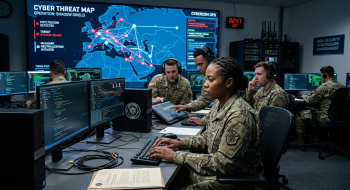
For years cyber operations were treated largely as instruments of espionage”useful for stealing secrets or probing adversaries’ networks. That distinction is fading. Cyber capabilities are now being woven directly into military doctrine as tools of battlefield preparation. Disabling air-defence sensors, corrupting logistics systems, jamming satellite links or flooding networks with false information can weaken an opponent before the first missile is launched. In such conflicts, the line between the digital and physical battlefield all but disappears.
Recent wars offer clues to how this convergence is unfolding. In Ukraine, cyber intrusions have accompanied drone strikes and electronic warfare. Israel’s security doctrine increasingly combines intelligence operations, cyber capabilities and precision strikes. Reports surrounding Operation Epic Fury suggest the same logic: digital disruption preceding or amplifying physical attacks. Cyber operations in this model serve as strategic softening”blinding sensors, confusing command chains and slowing response times before conventional force is applied.
The uncomfortable question is who is actually prepared for such conflicts.
A small group of major powers has invested heavily in cyber capabilities. America operates a large cyber command integrated with military planning. China has built formidable digital capabilities within its strategic support forces. Russia has repeatedly demonstrated its willingness to deploy cyber operations alongside military pressure and information warfare. For these states, cyber conflict is no longer experimental; it is doctrine.
Some smaller countries have also taken the threat seriously. Israel has tightly integrated its military, intelligence and technology sectors. Britain has established a national cyber force. Estonia, after suffering large-scale cyber attacks in 2007, built one of the world’s most resilient digital infrastructures. South Korea, facing constant digital pressure from North Korea, has likewise prioritised cyber defence.
Elsewhere, the picture is less reassuring. Many countries are rapidly digitising their economies and public services without building the institutions needed to defend them. A rough comparison illustrates the imbalance. Major cyber powers such as the United States, China and Russia combine very high digital dependence with advanced cyber commands embedded in military doctrine. A smaller group of technologically sophisticated states”including Israel, Britain, Estonia and South Korea”also shows high digital dependence but has built robust national cyber-defence institutions. By contrast, many digitising economies across Asia, Africa and Latin America now depend heavily on connected infrastructure while possessing only limited cyber-security capacity. In developing states, digital reliance is rising quickly but cyber defences often remain fragmented or minimal.
Complicating matters further is the fact that much of the infrastructure likely to be targeted in cyber conflict is owned not by governments but by private companies. Cloud providers, telecommunications firms, satellite operators and software vendors now form a crucial part of national security architecture. A disruption at a major technology company can cascade across financial systems, logistics networks and military communications.
This has effectively turned cyber conflict into a form of public“private warfare. Governments increasingly rely on technology firms to detect intrusions, analyse malicious software and restore compromised systems. During major cyber incidents, private companies often become the first responders. Yet coordination between states and industry remains uneven, and legal frameworks governing such cooperation are often unclear.
Artificial intelligence may soon accelerate these dynamics further. AI systems are beginning to assist both attackers and defenders in identifying vulnerabilities, analysing network traffic and automating responses to threats. Offensive cyber tools enhanced by machine learning could shorten attack cycles dramatically. Tasks that once required weeks of reconnaissance and coding might eventually be executed in minutes.
Defence systems, however, remain slower. Bureaucratic processes, fragmented authorities and limited information sharing frequently hinder government responses to cyber incidents. As digital infrastructure grows more complex, the challenge of defending it grows harder still.
The result is a widening readiness gap. Nations are digitising their economies, militaries and public services at extraordinary speed, yet the policies governing their protection remain incomplete. Supply chains, financial systems, satellites and cloud infrastructure have become strategic assets”but they are not always treated as such.
Cyber conflict rarely resembles conventional war. It unfolds quietly: corrupted databases, disrupted communications or paralysed logistics networks. By the time missiles fly, the decisive blows may already have been struck in code.
Episodes such as Operation Epic Fury suggest that cyber operations are becoming inseparable from modern warfare. Ministers and generals should draw a clear lesson. Preparing for future conflict no longer means only buying tanks, ships or aircraft. It means securing networks, strengthening public“private cyber alliances and building institutions capable of responding at digital speed. Otherwise the next war may begin long before anyone realises it has started.