This is an interesting work, even if it needs further debate (and even challenge). Cardozo was a Congress politician not long after the Official Language Act was passed. He had the ear of those in power for quite some time. Cardozo himself has also been a prominent player in the Dalgado Konknni Akademi (DKA), the network campaigning for Romi Konkani rights.
Added to that, not everyone in the Romi camp agrees with the approach the DKA has taken. Undeniably, they have campaigned for many years and even decades. But the ultimate goal--that of ending the outright discrimination against the Romi script of Konkani as outlined in the Official Language Act, 1987--is anywhere closer now. Hence, newer groups sprouted on the scene in the 2020s, like the Global Konkani Forum, from which too in time split away the Global Romi Lipi Abhiyan. These are realities, but some of the points raised by Cardozo also needs acknowledgement and discussion.
Quickly after the comment on his book, in my WhatsApp inbox a message from the committed lexicographer Damodar Ghanekar showed up. This compiler of dictionaries' commitment to Konkani is as deep as his belief that Nagari is the only legit script that Konkani should be written in.
'Dambab' wrote: "Is Tomazinho OR anyone else ready for a one to one debate on the subject of script? Can you please show examples of the PersoArabic & Malayalam scripts being used NOW??" [Emphasis his.]
The idea of a debate would be a good one, provided it's fair, not drowned in applause or ridicule, or favouring one side. But it was the comment on the smaller scripts of Konkani (Perso-Arabic and Malayalam) that got one thinking.
Let's assume for a moment that there's nothing happening in these scripts. That everyone has stopped using and writing in the same. Does that imply that it's a good thing? Should we be celebrating the death of certain traditions in Konkani simply because (i) they are not our own (ii) we do not understand them (iii) we care zilch for their historic knowledge encoded in them over generations and centuries?
This is like celebrating the amputation of one part of our body, just because, say, the pain we were feeling in our leg has gone away. Script diversity is not gangrene. It is a wealth that needs to be nourished. (With time, tech solutions like the website konkanverter.com have made four scripts mutually intelligible to each other. Hopefully, some tech solution will come for the right-to-left Perso-Arabic script too.)
For long, Nagari supporters have adopted a reductive dismissal approach, brushing aside substance by treating it as insignificant. So, the fact that the smaller scripts of Konkani (Perso-Arabic, Malayalam) are under intense pressure, means that other, vibrant scripts like Romi and Kannada can also be deprived of their fair deal. This is not fair. Neither is it true.
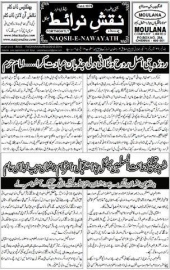
A friend shared a recent printed copy of the newspaper, Naqsh-e-Nawayath, published in the Perso-Arabic script of Konkani. Till not many years back, Malayalam-script Konkani had its own books printed. Likewise, Konkani speakers in Kochi are carrying banners in Malayalam-script Konkani and writing in that script.
As far as books being printed in a language, dialect or script goes, a lot depends on the 'demand'. If there are printers and publishers willing to undertake that work, then people will keep writing in it.
On the other hand, an artificial 'demand' can also be created. In Goa, there's considerable funding for works in Nagari Konkani and Marathi (and Romi, to a lesser extent). This generates work in such languages, the associated dialects and scripts. Whether it's read or not is another matter altogether.
Let's not see language as a tool to 'block' people, but one which empowers them. By giving them the chance to speak or write in a language of their choice.
For long, we have acted as if Konkani would "protect" Goa from "outsiders", safeguard jobs, and somehow freeze Goa in time. But this can also exclude some sections of Goans (as Cardozo complains). Many in this outmigration-prone state have also suffered considerably due to such an approach.
Language in Goa should not be decided by size, age, "popularity", or political support alone. We have seen how arbitrarily such approaches have been used. Cardozo himself points out (without saying so in as many words) how politics has played a despicable role in Goa since 1987, and before.
Every speaker and every variant matters. To argue that one script is more important because it is older, more 'nationalistic', more 'Indian' than others, less 'foreign'... all might sound good on paper. But this damages the interest of the language as a whole, and is killing it.
It is also time to make it easier for people to learn Konkani--any variant of it. This is the need of the hour.
A more empowering approach to promoting Konkani needs to start with openly accepting that Konkani is not one uniform form. Rather it is a family of living varieties; cutting across scripts, dialects, religions, regions and diasporas.
Instead of framing diversity as fragmentation (Roman vs Nagari, Antruzi vs Bardezi or Saxtti and Pednemkari, Goan vs Mangalorean, etc.), plurality should be seen as linguistic richness.
In short: let's shift from “standardization-first” to “access-first". Language promotion should move from identity policing to capability building.