Yet, these signals and dog-whistles are going unchecked. So much so that one wonders whether those who should know better are either completely unaware of the same, or simply choosing to turn a blind eye. There is another possibility too: this gets tacit encouragement for political reasons, including our shortly-due elections.
Today is seen as the opportune time to rake up religious conflict and rivalry from centuries ago. Historically grounded points are spiced up with a strong rhetorical framing. Selective emphasis is placed on some convenient details, covered in strongly emotionally loaded language.
Bias comes less from inventing history outright and more from how it frames the Portuguese period, seeing it almost entirely through the lens of religious conflict. This reduces the complexity of Goan history to a cliche; but a politically useful one nonetheless.
Such propaganda uses highly emotive and "absolutist" language. It sees Goa as “one of the most violently colonised parts of India,” a “battlefield for the soul of a civilization,” a place which saw “complete takeover... and cultural erasure”. Then, it moves ahead to create a dramatic moral narrative. History becomes a story to be told in stark oppressor-victim terms.
Present-day identity politics get projected onto the past. The repeated framing of “we” versus “they” turns a complex colonial history into something like a modern communal identity narrative. Speakers portray Hindu Goan identity as the authentic or original Goa, implicitly positioning Christian Goa as being derivative or imposed.
Let's get some things clear. Religious intolerance did exist. But that does not justify reinventing the bias and bigotry of the 16th century again in the 21st.
Some stories are repeated, while others forgotten. Facts which go against this communal narrative are overlooked. For instance, there's no space to talk about voluntary or socially advantageous conversions. Let alone the mixed cultural developments that Goa has seen. Or the centuries-old Konkani Catholic literary traditions. Or even fields like Indo-Portuguese architecture, music, law and education where conflict is not the overriding theme.
Significantly, Goa is not alone in facing such trends.
Currently, India has weaponised the whole Mughal period, and thus large parts of its own history. Teaching about this period has been wiped out or minimised in some classes. Like the Portuguese, the Mughals too are presented almost exclusively as religious fanatics driven by crusading zeal.
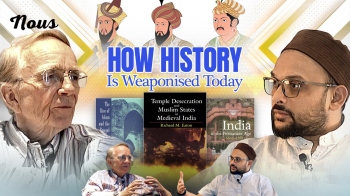
We could take a cue from Richard Maxwell Eaton, the American historian and professor of history at the University of Arizona, known for having notable books on the history of India before 1800. He has some insights on this issue which might come as a surprise for those who buy the propaganda.
According to Eaton, temple desecration in pre-modern India was a real phenomenon, but it has often been exaggerated and selectively interpreted in modern communal narratives. Eaton argues that while some Muslim rulers did destroy temples, these acts were usually political rather than purely religious. Temples were closely tied to royal authority, wealth and legitimacy. So conquering kings (whether Hindu or Muslim) often attacked the symbolic centres of rival powers. In his influential study of temple desecration, he documented around 80 confirmed cases over several centuries, far fewer than the thousands sometimes claimed in polemical accounts.
He also stresses that Indo-Muslim rule was complex and cannot be reduced to a simple story of “Hindu versus Muslim.” He points out that many Muslim rulers patronised Hindu temples and employed Hindu elites, while Hindu kings too had histories of plundering rival shrines.
One on his explanations is here: https://tinyurl.com/2482emt4 or https://www.youtube.com/watch?v=Hxj00aKgYyw In it, Eaton says India buys the "usual story" that the 12th century saw the coming of Islam, and India's dominance for a long time, of six to seven centuries, by Muslim rulers.
As he puts it, "That, in turn, sets up this whole trope of Hindu versus Muslim. The temptation is therefore to see the South Asian past through the lens of religion. I think that was largely a function of historiography of the 19th century, the way the British were teaching history."
Eaton sees destruction of places of worship as going on in India since "at least the sixth century". Hindu kings too were destroying each other's temples as a part of conquest. Such facts show the issue in entirely different light.
Destruction of religious sites was unfortunately common across many societies in the early modern world and was not unique to India. Protestant iconoclasts in places like the Netherlands, England, Scotland and parts of Germany attacked Catholic shrines. Catholic rulers suppressed Protestant churches. In Portugal itself, medieval Muslim mosques had earlier been converted into churches during the Reconquista.
Religious places were not only places of worship but also symbols of royal legitimacy, economic wealth and political authority. Understanding the history of the Cholas, Shaiva-Vaishnava rivalries and attacks on Jain or Buddhist establishments during sectarian conflicts could give us very different perspectives.
But we insist on seeing this in purely modern religious terms. “Weaponising” means deliberately using an idea, identity, law, emotion, technology or piece of information as a tool to attack, manipulate, discredit, pressure or gain power over others. This is exactly what is happening today.