While São João is known all over for its colourful Kopels and the leap of faith, there is yet another lesser-known tradition observed in Goa. The Zavaianchem Fest, or the Feast of the Son-in-Law, takes place in many Goan households in the days leading up to São João celebrations. Often celebrated as a day of thanksgiving for newlyweds, it is also observed as a day of gratitude by families with newborns born during the preceding year.
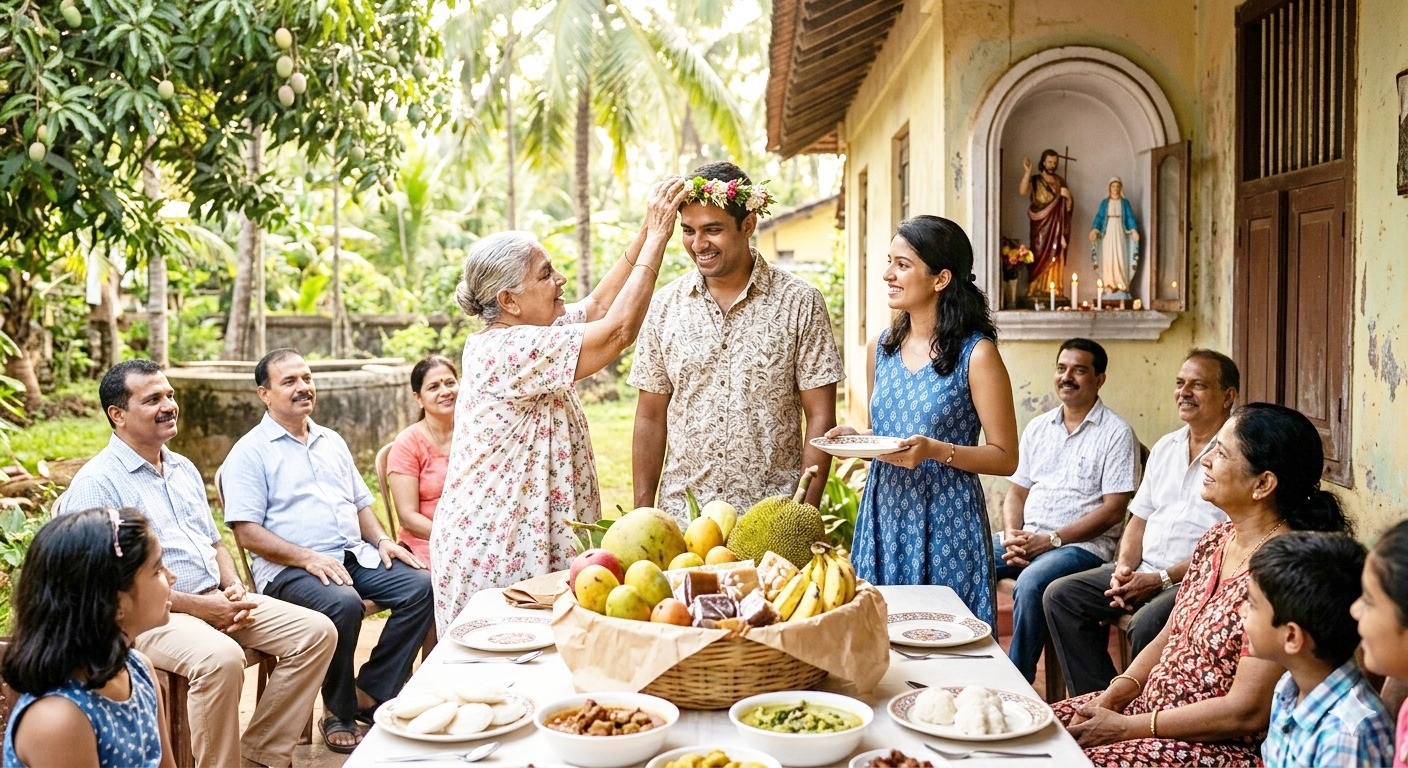
The daughter generally comes to her mother’s home around this time of year, and the son-in-law is then invited over and visits his wife’s maternal home, thus being part of the São João tradition and festivities. The newly married son-in-law is then usually invited for lunch by his mother-in-law, following which the son-in-law is warmly welcomed with much fanfare and traditional Goan dishes. Family members offer their prayers and sing hymns dedicated to honour Saint John the Baptist, the Virgin Mary, and other saints. The son-in-law is then told to put on the ‘kopel,’ the headgear which is the distinct element of the festival, and they then have to take the leap of joy, mentions Clarice Vaz, a writer and an artist. “Earlier, I remember the young boys used to wear the kaxti and then jump into the well,” she remarks.
“The son-in-law is treated as the guest of honour during the festival, and the family leaves no stone unturned to host him,” she remarks. Traditional Goan dishes and sweets such as sanna (a steamed rice cake fermented with coconut palm toddy), verdur (pumpkin cooked in coconut milk, along with spices and shrimps), and pork vindaloo, Goan Doce (traditional Goan sweet made from split chickpeas (chana dal), grated coconut, and sugar, and other sweets made from fresh jackfruit are often prepared for the celebratory lunch.
Once the festivities are over, the couple generally returns home or may decide to stay also. But when they do return home, the mother-in-law of the groom presents them with the ‘ojem,’ which is a bamboo basket with sweets, gifts, and fruits. This ojem is filled with various delicacies. Upon reaching his own home, the ojem is generally placed at the oratory of his house, following which everyone recites a short prayer and then distributes the contents among his family members and other villagers. This is meant to signify that a marriage is not just between two families but between two villages.
“We Goans follow a very syncretic form of faith that is followed by no one else,” mentions Vaz, with a smile. “Similarly, this tradition is said to have been taking place long before the Portuguese came here, because I remember when Late Rev Fr Nascimento Mascarenhas used to come to our place, he mentioned a similar tradition which is followed by the Hindus as well,” she remarks. The Hindu tradition is marked by the daughter going to stay at her mother’s place during the month of Ashadha, which usually coincides with São João. “Then came the colonial rule and then the conversions; it was not so easy for an outsider to convert a person of the land, thus many of the festivities and traditions stayed,” she remarks.
Over the years, much has changed. The number of wells has declined, and busy schedules leave little time to pause and appreciate life's simple pleasures. Yet festivals like these continue to hold their relevance, reminding people to celebrate together and reconnect with nature's most essential element. “Earlier, the whole waddo celebrated festivals together, everybody knew everybody, now that our families have become nuclear, things are changing,” she comments. Yet, she believes the community spirit has not and will never change. In many ways, Zavaianchem Fest is more than just a celebration for a son-in-law. It is a tradition that strengthens family bonds, connects villages, preserves Goa's syncretic heritage, and keeps alive the spirit of togetherness that has long defined Goan society.