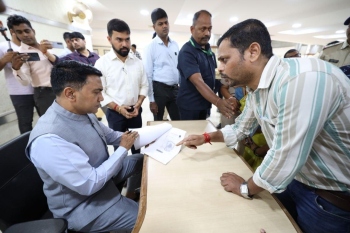
It has been four days since an outbreak of diarrhoea among residents of Prabhu Violetta, a high-end residential complex at Dabolim, has affected over 150 residents. The outbreak, whose true origin is yet to be officially confirmed, although tests are underway, is believed to have been caused by the consumption of contaminated groundwater, a situation potentially exacerbated by a malfunctioning sewage treatment plant. The incident highlights a glaring loophole that exposes state failure of the highest level -- the willingness to abdicate responsibility in order to placate the interests of private profit.
What’s clear is that the residents of this colony -- like many who live in similar constructions -- rely on private sources of water to meet their needs, be it a borewell, privately supplied tankers or a combination of both. The reason is that, despite not having the capacity to supply potable water to these new housing units, the government has been granting permission for them to be built anyway.
Who suffers are the unsuspecting buyers of these residential units, while the builders and those who sanction these projects are laughing all the way to the bank. Activists and right-thinking people in Goa have, for years, been complaining that the indiscriminate sanctioning of new residential and commercial constructions, including those with private and individual swimming pools, was placing a severe pressure on limited natural resources, especially the availability of groundwater, putting pressure on garbage collection mechanisms and other scarce resources.
Repeated attempts to get the government to see reason and allow new constructions only after the capacity for water supply, garbage collection and roads built to handle the traffic are available have fallen on deaf ears. The result is what the residents of Prabhu Violetta are facing today -- having to rely on untreated water, sucked out of the ground using a borewell, whose legality is contested and whose water is proven unfit for household use.
An FIR has been lodged against the builder and the Goa State Pollution Control Board, which has woken up to the issue following complaints has been found that the sewage treatment plants haven't been functioning as desired and has issued a notice to the builder asking them to pay fines. Caught in the middle are the buyers of the residential units, who are sandwiched between an uncaring government, an unscrupulous builder, and a network of brokers, corrupt bureaucrats and city planners whose only objective seems to be the hasty approval of newer and bigger residential complexes. It is an extremely short-sighted approach.
The government’s decision to allow for the construction of new residential complexes on the condition that they arrange for their own water and make no claims for PWD-supplied water -- as has been happening in certain locations for several years now -- is not only an abdication of its responsibility, it is directly placing the lives of those who ultimately buy these complexes at risk.
This system needs to stop. The government must cease granting permissions for mega projects until it has the ability to supply these locations with piped potable water, or express its inability to do so to those who come with applications.